Desk note N° 002·Macro·9 March 2026
Wall Street’s “short war” comfort blanket has been pulled away.
Last week the consensus was that $100 oil was a tail risk. As of Monday’s close, Brent is at $114, Hormuz tanker transits have collapsed by 83%, and the major equity indices are belatedly repricing for a prolonged conflict. This is the note we wrote on 9 March: what happened, what it means for inflation, growth, and central bank policy, and a tactical positioning framework for the weeks ahead.
By Elle Dani · Founder & CIO, els.capital
01 / The price shock
The price shock
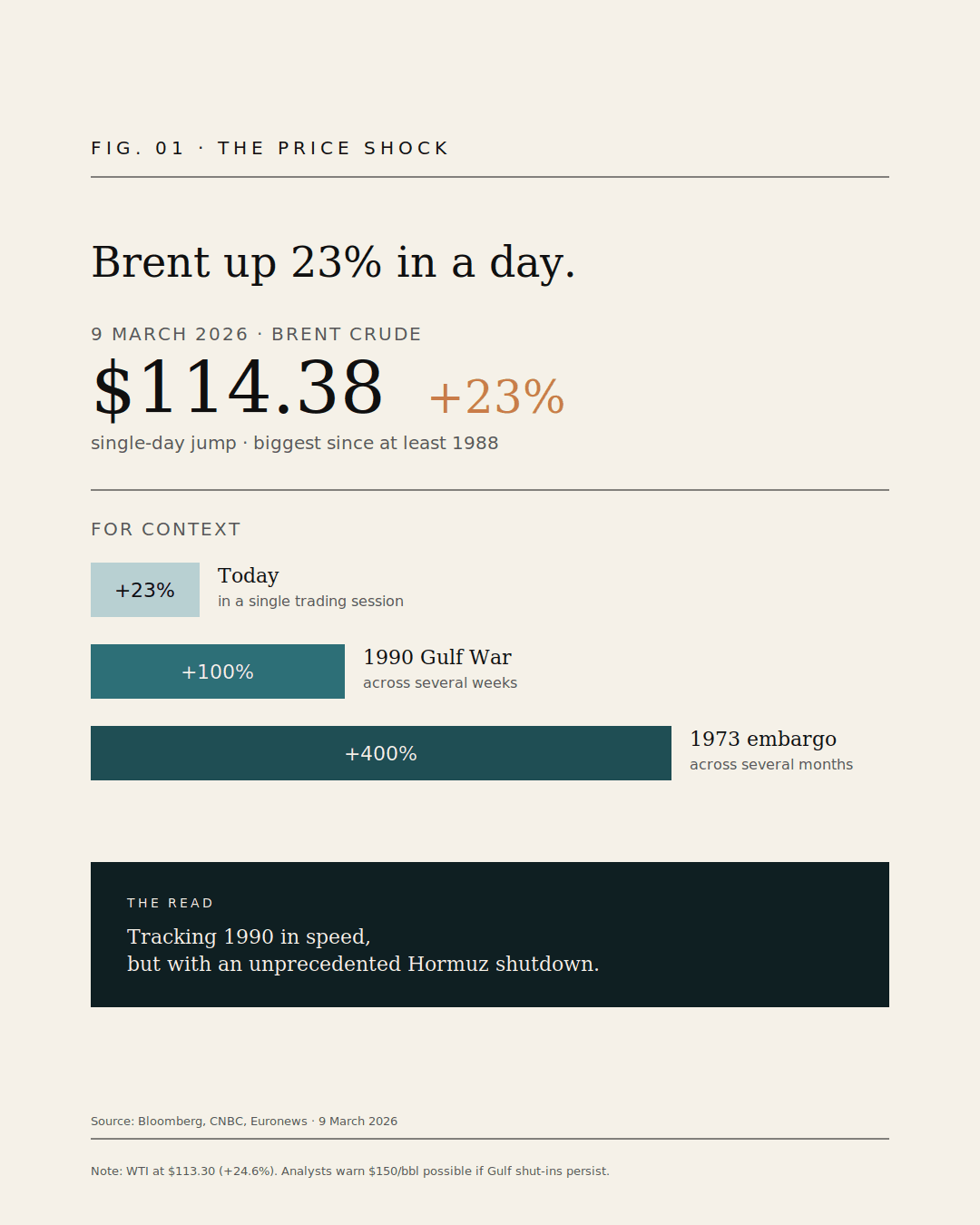
Brent crude closed at $114.38 on Monday — a single-day move of +23%, the largest one-day jump in oil prices since at least 1988. WTI tracked it almost step for step at $113.30 (+24.6%). For context, the 1990 Gulf War took several weeks to deliver a 100% move; the 1973 embargo took several months to deliver 400%. This shock is tracking 1990 in speed, but with an unprecedented Hormuz shutdown layered on top.
US gasoline reached $3.41 a gallon nationally on the same day, with pump prices expected to top $4 within weeks. Gulf producers are shutting in oilfields. Qatar’s energy minister told the FT that the war “could bring down the economies of the world.” Analysts are now openly discussing $150/barrel if Gulf shut-ins persist for more than a few weeks.
02 / The ten days that broke the “short war” trade
The ten days that broke the “short war” trade
The market spent the first week treating this as a contained, short-duration event. That assumption broke between 3 and 9 March.
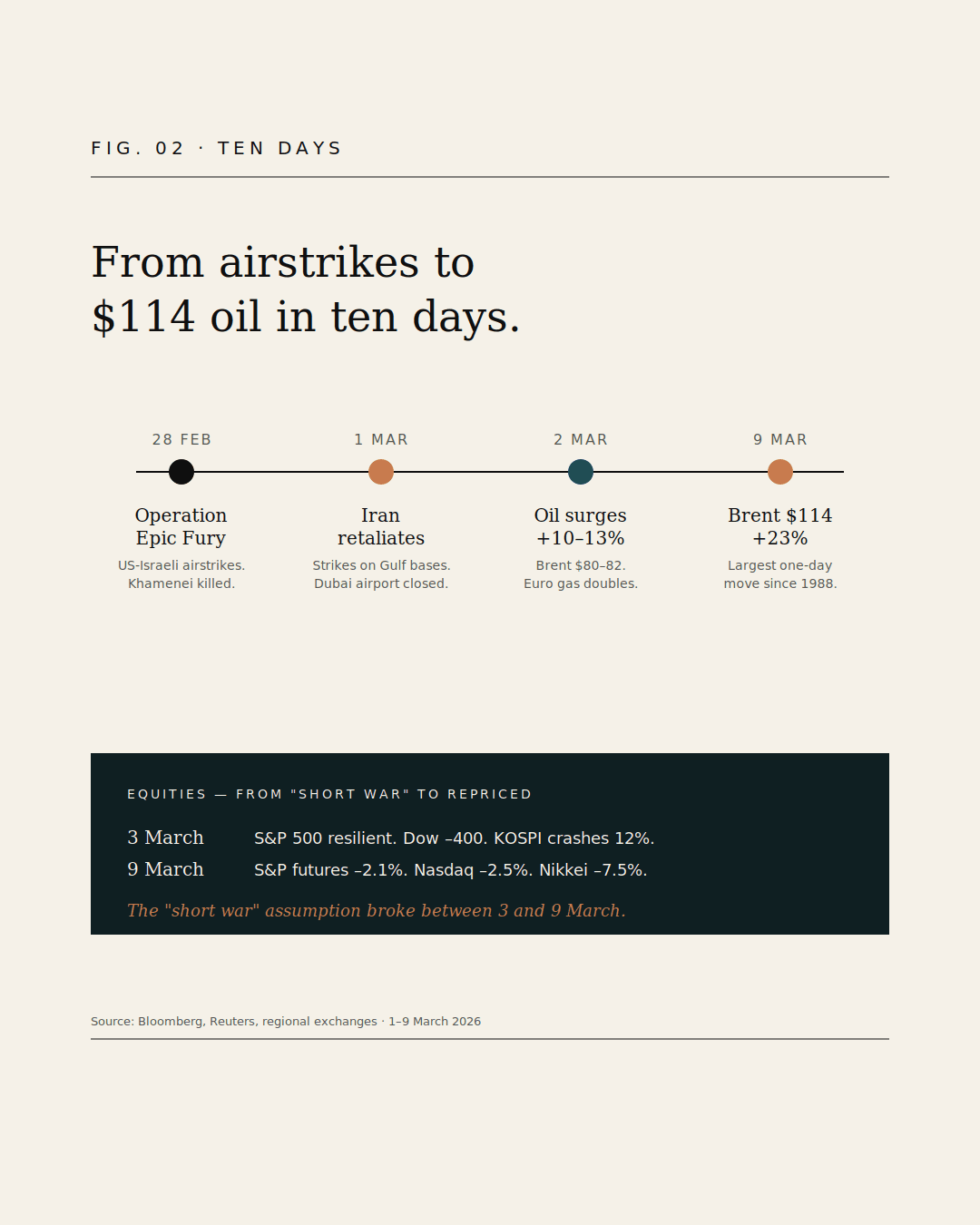
On 3 March, the S&P 500 was still relatively resilient — Dow −400 points, KOSPI down 12%, but US futures absorbing the shock. By 9 March, S&P 500 futures were −2.1%, Nasdaq −2.5%, and the Nikkei dropped 7.5% in a single session. Asian markets are taking the worst of it; KOSPI’s 12% crash on 4 March was the canary, and a fresh wave of EM selling pressure is now compounding it.
JP Morgan’s 80-year dataset on geopolitical shocks is still cautiously relevant: markets typically underperform in the first three months and recover at six to twelve. But that pattern is conditional on the shock being containable. A prolonged Hormuz closure changes the calculus.
03 / The chokepoint
The chokepoint
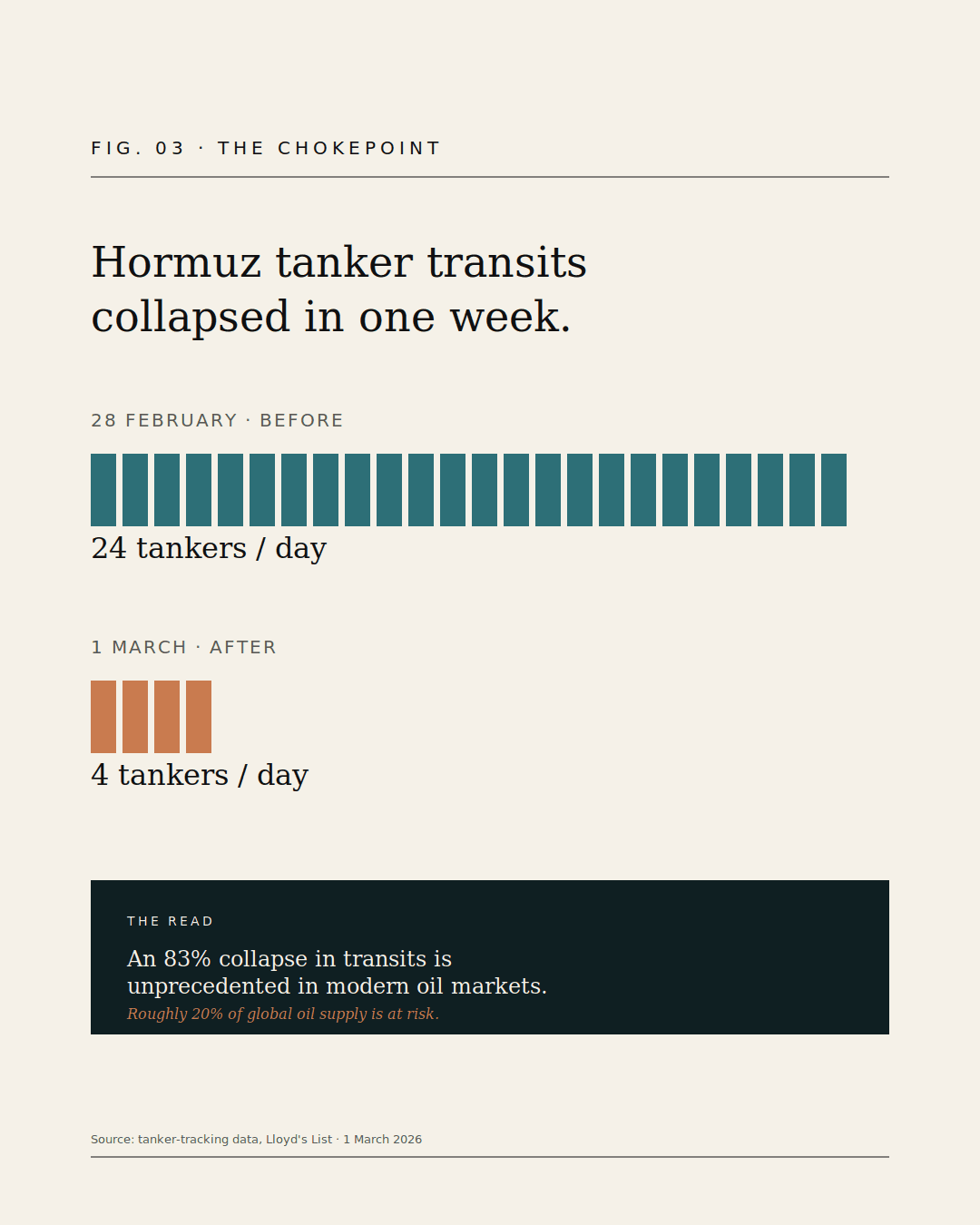
Strait of Hormuz tanker transits collapsed from 24 a day on 28 February to 4 a day by 1 March — an 83% reduction in shipping volume in 72 hours. Roughly 20% of global oil supply moves through this single strait. The closure is not theoretical; it is operational.
Iraq and Kuwait are already cutting output. UAE is likely next. Per Rystad Energy, even a post-conflict restart would take weeks to months — supply does not snap back. This is where the “tail risk” framing breaks down: the chokepoint is already partially closed, oil is already at $114, and the offsets are limited (SPR, Gulf spare capacity, ceasefire) but not yet activated.
04 / The central bank trap
The central bank trap
The war in the Middle East could bring down the economies of the world.
— Qatar’s Energy Minister, FT, 7 March 2026
Central banks now face a problem with no clean solution.
Path A: rising oil feeds directly into headline CPI, inflation re-accelerates, and rate cuts that markets had priced for mid-2026 get deferred to late 2026 or into 2027. Path B: rising energy costs squeeze consumers and corporates, growth slows, and recession risk climbs. Both paths are running simultaneously. The destination, if it persists, is stagflation.
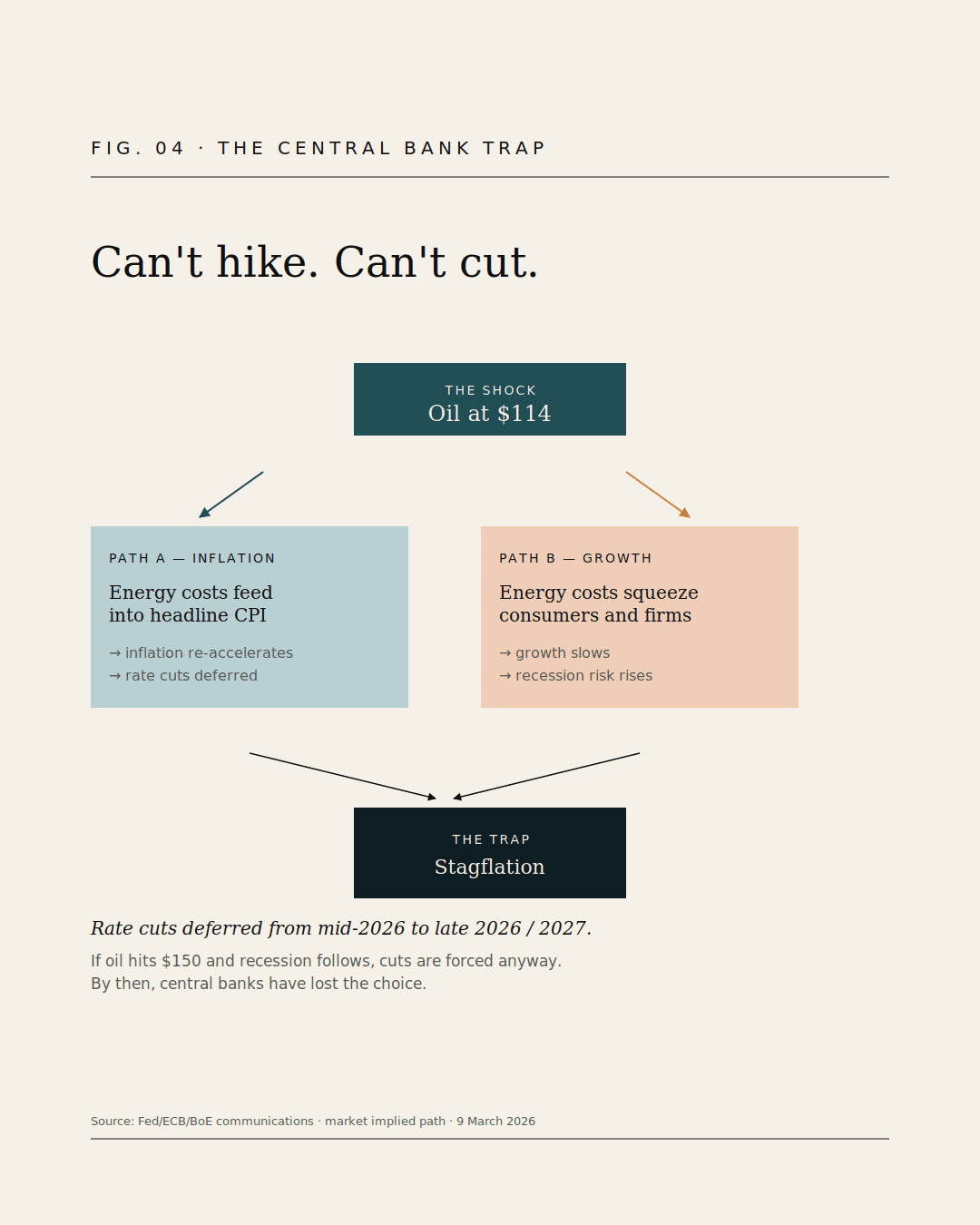
The Fed and ECB will not slam the brakes into an oil shock — that’s not how they read their mandates. But they cannot credibly cut into accelerating CPI either. The result is paralysis: rates stay high, the economy slows, and the eventual cuts arrive only after recession is already visible. The UK and Europe are particularly exposed via energy import costs; the BoE is in the same trap and arguably worse positioned given European gas pricing.
05 / Sectors and regions
Sectors and regions
The dispersion is wide and the pattern is recognisable from previous oil shocks. Energy producers, defence and aerospace, gold, and US dollar assets are the clearest beneficiaries. Airlines, consumer discretionary, EM equities, and long-duration fixed income are the clearest casualties. Morgan Stanley is recommending multi-year defence exposure. Oil majors are repricing fast. Long bonds are getting hit on the yield side.
The EM stress channel is worth watching closely: KOSPI has crashed 12%, Thailand is down 8%, and the combination of FX reserve depletion, current account widening, and USD-denominated debt becoming unserviceable is already showing up in funding markets. This is where the next leg of contagion typically appears.
06 / The positioning framework
The positioning framework
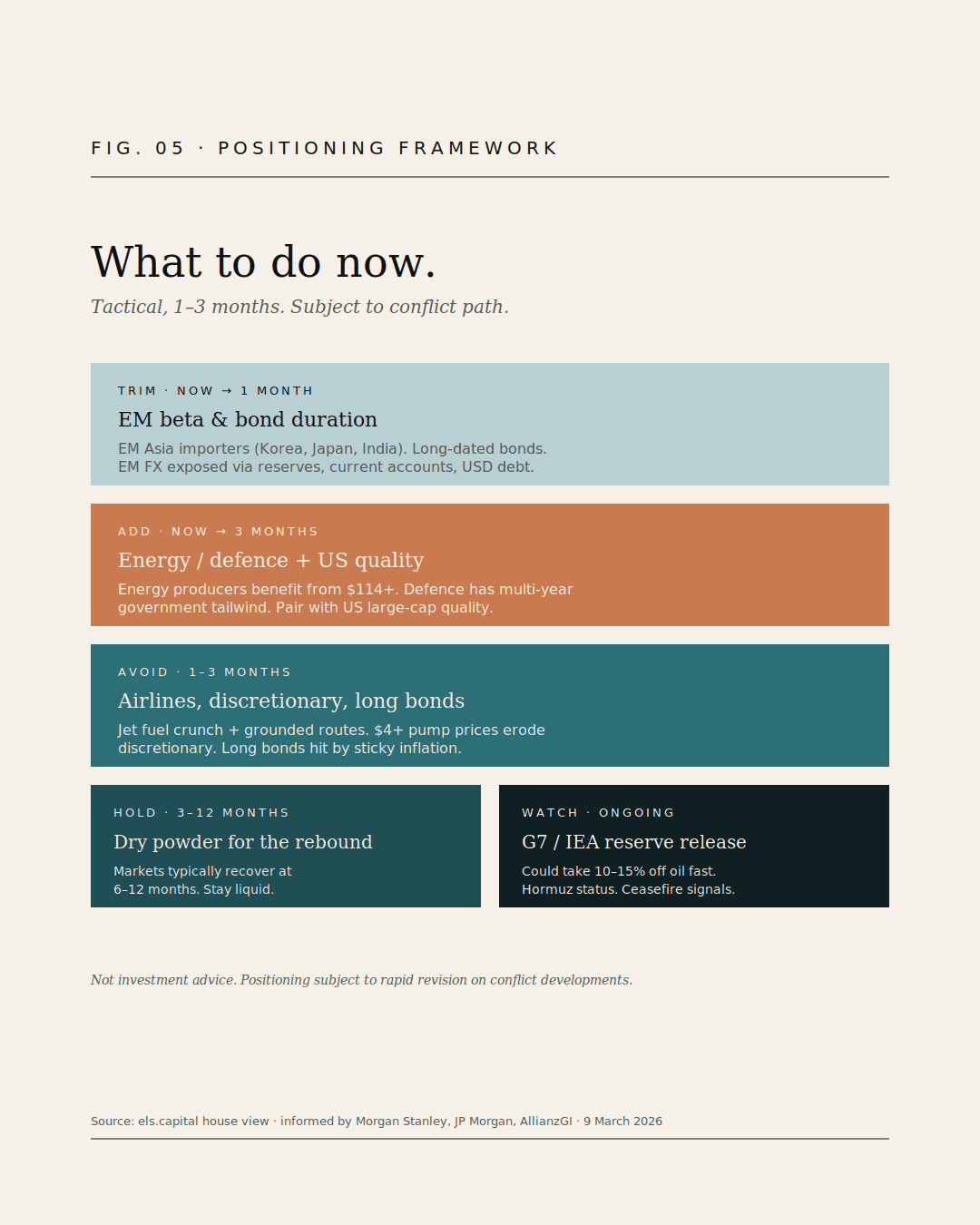
Tactical, 1–3 months, and explicitly subject to revision on conflict developments. This is how we are thinking about it.
- Trim
EM beta and bond duration first. EM Asia importers (Korea, Japan, India) are most exposed; long-dated bonds are taking yield-driven capital losses; EM FX is exposed via reserves, current accounts, and USD-debt rollover risk.
- Add
Energy producers and defence as a barbell, paired with US large-cap quality (low debt, pricing power) as a domestic earnings buffer. Energy producers benefit directly from $114+ crude; defence has multi-year government spending tailwind that doesn’t reverse on a ceasefire.
- Avoid
Airlines (jet fuel crunch plus grounded routes), consumer discretionary ($4+ pump prices erode disposable income), and long-dated bonds (sticky inflation plus deferred cuts).
- Hold
Dry powder. Markets typically recover at 6–12 months post-conflict. Liquidity to deploy on a ceasefire signal or Hormuz reopening matters more than incremental yield right now.
- Watch
The G7/IEA strategic reserve release. A coordinated SPR release could take 10–15% off oil prices quickly. Hormuz status and ceasefire signals are the other two circuit-breakers. Position should adjust rapidly on any of these.
Our view
The base case is no longer “short conflict, contained shock.” It is “prolonged disruption, deferred policy easing, stagflation risk.”
Probability of $150 Brent within 30 days is non-trivial — conditional on Hormuz remaining at 4 transits a day or fewer. Probability of a coordinated SPR release within 10 days is rising. The single highest-impact catalyst from here is whichever resolves first: the chokepoint reopening or the reserve release activating. We are positioned for both being delayed, with explicit upside hedges if either accelerates.
The takeaway
The question for central banks isn’t “do they hike from here?” It’s “how long can they stay stuck?” The honest answer is: until either oil retreats or recession arrives. Neither is in their control.
In an oil shock, alignment isn’t a strategy. Optionality is.
Source documents
- Bloomberg, CNBC, Euronews oil pricing data, 9 March 2026.
- JP Morgan, “Markets and geopolitical events,” 80-year dataset.
- Morgan Stanley defence sector update, March 2026.
- AllianzGI macro note, “The stagflation question,” 7 March 2026.
- Rystad Energy on Gulf shut-in restart timelines, March 2026.
- FT interview with Qatar’s energy minister, 7 March 2026.
© els.capital 2026 · Written 9 March 2026 and preserved as written · Conditions and positioning will have evolved · Informational purposes only · Not investment advice.